Research Sharing, Bile Acids Solve the Problem of Hepatopancreas Injury in Shrimp Caused by Low-Fishmeal Feed
Author:Lachance
Time:2026-04-07
Hits:
Against the backdrop of transformation and upgrading in the aquaculture industry, the promotion and application of low-fishmeal feed have become a key direction for reducing costs and alleviating resource dependency. However, low-fishmeal formulas easily lead to hepatopancreas injury in Litopenaeus vannamei, restricting the improvement of farming efficiency.
Professor Li Xiaobo's team at East China University of Science and Technology focused on this industrial pain point and conducted a specialized study on the protective effect of bile acids on shrimp hepatopancreas health under low-fishmeal diets. With precise experimental design and meticulous cytomorphological analysis, they achieved breakthrough results, providing an effective strategy for solving hepatopancreas challenges in shrimp farming.
The team used Litopenaeus vannamei as the experimental subject and constructed a low-fishmeal diet model for a control trial. Healthy shrimp with an initial weight of (1.2±0.1)g were selected and randomly divided into 3 groups, with 4 replicates per group and 40 shrimp per replicate. The culture period lasted 56 days.
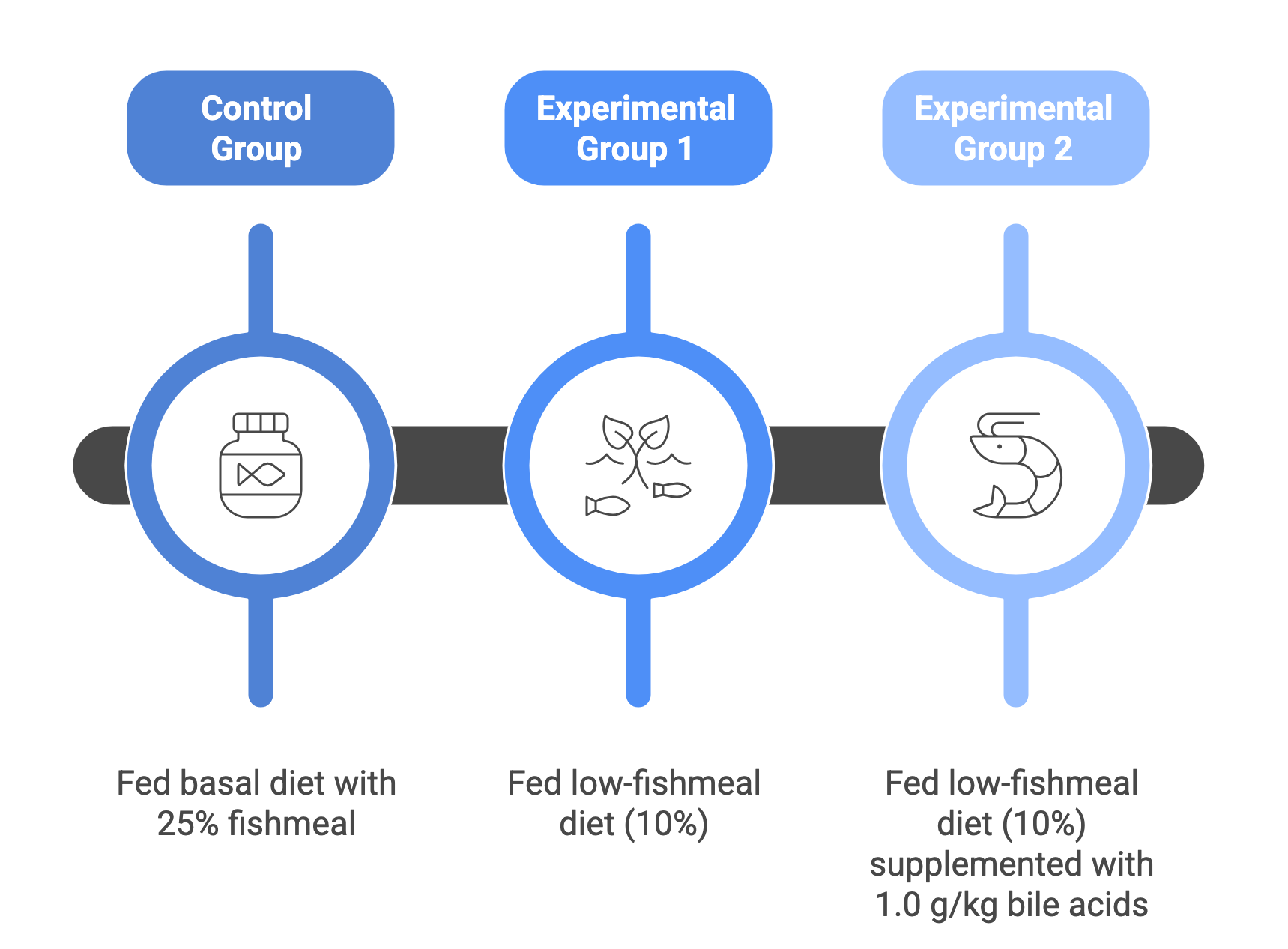
The Control Group was fed a basal diet with conventional fishmeal content (25%), Experimental Group 1 was fed a low-fishmeal (10%) basal diet; Experimental Group 2 was fed a low-fishmeal (10%) diet supplemented with 1.0 g/kg of bile acids. Environmental conditions such as water temperature (28±1)℃ and salinity(25±2)‰ were kept consistent throughout the process. The monitoring focused on shrimp hepatopancreas health indicators and cytomorphological changes.
After the culture period, the team first conducted a statistical analysis of hepatopancreas lesion rates. Data showed that the lesion rate in the control group was only 8.3%, while the rate in the low-fishmeal group without bile acids was as high as 35.6%, mainly manifesting as dull hepatopancreas color and loose texture. In contrast, in Experimental Group 2 (with bile acids), the lesion rate dropped to 11.2%, showing no significant difference compared to the control group. This visually confirms that bile acids can effectively reduce the risk of hepatopancreas lesions in shrimp under low-fishmeal diets.
To further reveal the protective mechanism, Professor Li Xiaobo's team performed cytomorphological observations of the hepatopancreas tissues using paraffin sectioning, HE staining, and optical microscopy. The results showed that in the control group, B-cells (secretory cells) had regular shapes and uniform cytoplasm, and R-cells (storage cells) were rich in nutrient granules. In the low-fishmeal group, B-cells exhibited swelling and cytoplasmic vacuolization, nutrient granules in R-cells were significantly reduced, and cell structural integrity was compromised.
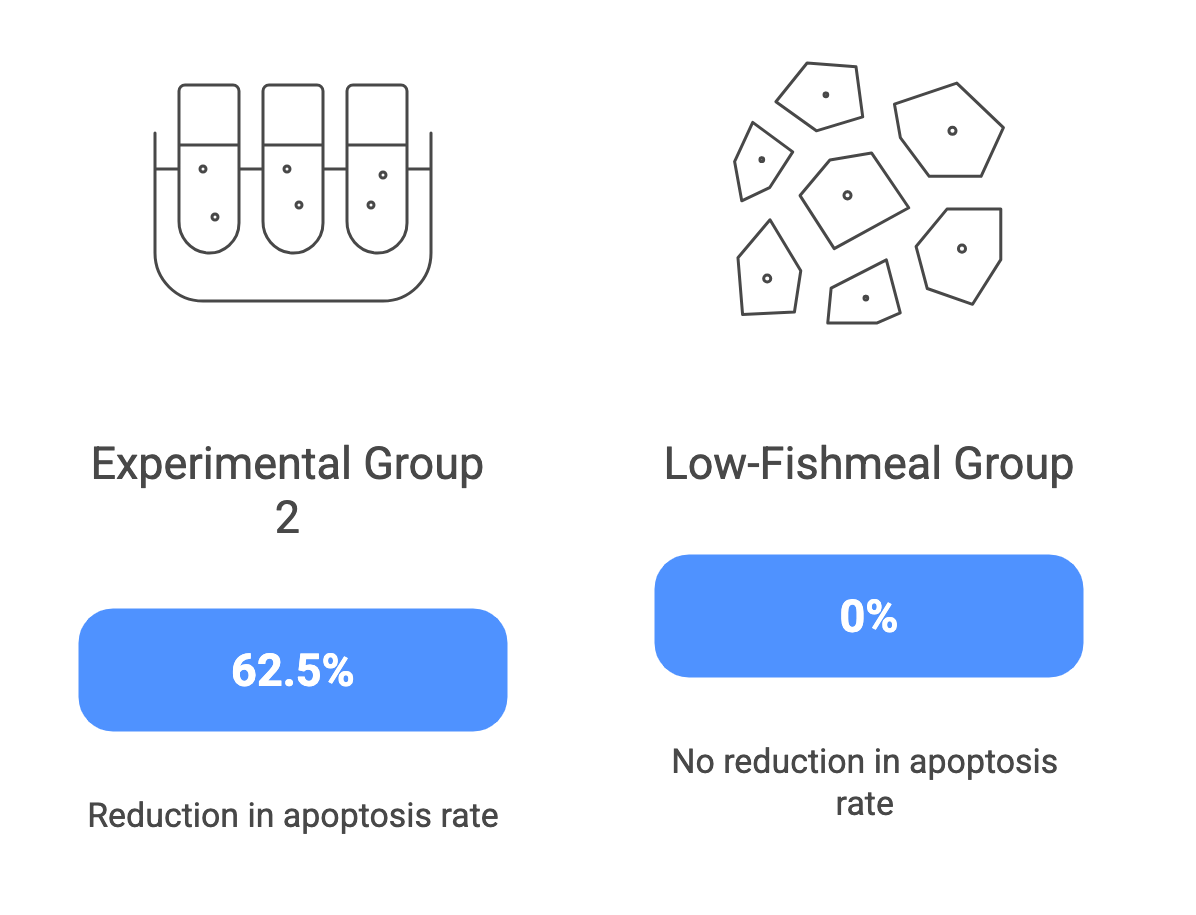
In Experimental Group 2 with added bile acids, the morphology of B-cells and R-cells basically returned to normal. B-cell secretory function was stable, R-cells had sufficient nutrient reserves, and the cell apoptosis rate was reduced by 62.5% compared to the low-fishmeal group. This provides authoritative and intuitive scientific evidence for the protective effect of bile acids at the cellular level.
Professor Li Xiaobo pointed out that low-fishmeal diets easily lead to digestive and absorptive dysfunction in the shrimp hepatopancreas, which in turn triggers tissue damage. An appropriate dosage of bile acids can achieve precise protection of the hepatopancreas by regulating cell metabolism and maintaining tissue morphological integrity.