



Trial Report: Application Effects of Bile Acids in Largemouth Bass
A 70-day scientific trial on Largemouth Bass has provided the answer: adding an appropriate amount of RUNEON bile acids to the feed not only significantly enhances growth performance but also strengthens disease resistance! We have compiled the core experimental data to give you an in-depth look.

Experimental Background: Why Choose Bile Acids?
Bile acids are the primary component of bile, possessing an amphiphilic molecular structure with both lipophilic and hydrophilic properties. They act as a "natural emulsifier," breaking down large fat particles into smaller ones, increasing the surface area for lipase action, and accelerating fat digestion and absorption (Hill MJ, 1995). Previous studies have also found that they assist in cholesterol metabolism and have even been used clinically to treat gallstones (Podda et al., 1989). But what is their specific effect in aquatic feed? This trial speaks with data!
Experimental Design

Trial Subjects: Largemouth Bass (initial weight 6.17±0.02g), purchased from Foshan and acclimated for 2 weeks before the trial.
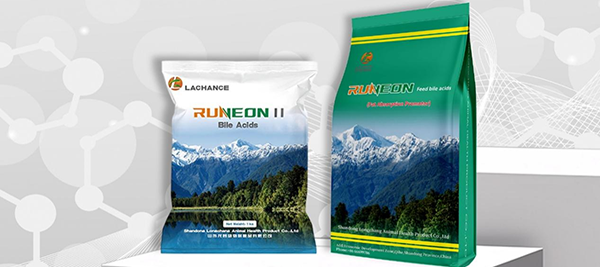
Test Substance: Runeon bile acids provided by Shandong Longchang Animal Health Product Co., Ltd (Lachance Group).
Dietary Settings: Six types of feed (D0-D600 groups) were prepared by adding 0, 80, 160, 240, 300, and 600 mg/kg of bile acids to a basal diet. Each group had 6 replicates with 30 fish per tank.
Culture Conditions: Conducted at the Nankou National Aquatic Feed Safety Evaluation Base, Beijing, using a recirculating water system with a water temperature of 25±3°C, dissolved oxygen > 7 mg/L, for a duration of 70 days (July 14 – September 21, 2014).
Experimental Results
1. Growth Performance: The 300 mg/kg Group Performed Best
After adding RUNEON bile acids, the "feeding" and "weight gain" efficiency of Largemouth Bass improved significantly:
Final Average Weight: The D300 group (300 mg/kg) reached 39.53g, 12.4% higher than the control group (D0 group at 35.15g);
Specific Growth Rate (SGR): Highest in the D300 group (2.63%/d), a 2.3% increase over the D0 group;
Weight Gain Rate (WGR): Reached 535.22% in the D300 group, 1.09 times that of the control group;
Feeding Rate (FR): 1.53%/d in the D300 group, significantly higher than the control group (1.45%/d).

2. Health Indicators: Dual Improvement in Antioxidant Capacity and Metabolism
- Antioxidant Capacity: The content of Malondialdehyde (MDA, a marker of oxidative damage) in the liver decreased significantly with bile acid addition. In the D300 group, MDA was only 2.47 μmol/g (vs. 2.71 μmol/g in the control). Indicators such as Total Superoxide Dismutase (SOD) and Total Antioxidant Capacity (T-AOC) showed an upward trend; SOD in the D600 group reached 11.99 U/ml (vs. 8.12 U/ml in the control).
- Fat Metabolism: Plasma High-Density Lipoprotein Cholesterol (HDL-C, "good cholesterol") reached 0.40 mmol/L in the D240 group (vs. 0.22 mmol/L in the control), an 81.8% increase, significantly promoting fat metabolism. Total Cholesterol (TC) also rose with increased dosage (D240 group: 2.67 mmol/L vs. control: 1.64 mmol/L).


3. Digestion and Reserves: More Active Intestines and More Stored Food in the Gallbladder
- Intestinal Digestive Enzymes: Midgut amylase activity in the D300 group reached 2.11 U/prot (vs. 0.43 U/prot in the control), an nearly 4-fold increase. Hindgut amylase activity in the D600 group reached 1.03 U/mprot (vs. 0.66 U/mprot in the control). Lipase activity also showed an overall increasing trend.
- Gallbladder Bile Acid Reserves: The bile acid content in the gallbladder of the D600 group reached 21,710.89 μmol/ml, 4.9 times that of the control group (4,432.07 μmol/ml), indicating that bile acids can be effectively stored in the gallbladder to function continuously.
Recommended Addition Amount
Based on a synthesis of growth performance, health indicators, and bile acid accumulation levels, the trial provides clear recommendations:
Optimal Addition Amount: Using specific growth rate, feeding rate, and total liver bile acid content as indicators, regression analysis yielded optimal addition amounts of 440.5 mg/kg, 283.3 mg/kg, and 253.8 mg/kg, respectively.
Recommended Range: 253.8~283.3 mg/kg (balancing both growth and health).
Maximum Safe Dose: 300 mg/kg (at this dose, growth performance is at its peak, and liver bile acid accumulation does not differ significantly from the D240 group).